

Cellometer X2 Fluorescent Viability Counter
Fluorescent automated cell counter for yeast, platelets and small cells
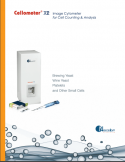
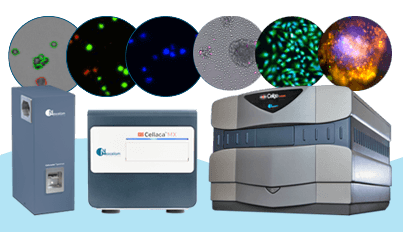
Features of the Cellometer X2 Image Cytometry System
Dual Fluorescence and Bright Field Imaging: staining of both live and dead cells in yeast samples
User-Friendly Software and Assay Selection: Enhanced inter-operator reproducibility, minimal training, auto-save option
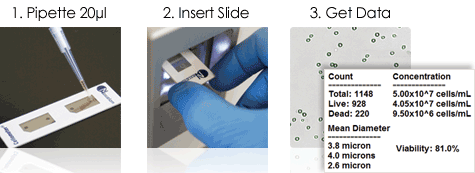
Fast Results: Obtain cell images, counts, size measurements, and viability calculations in 60 seconds
Small Sample Size: Only 20 µl of sample
Broad Dynamic Range: Measurable concentration range of 2.5 x 10⁵ to 5 x 10⁷ cells/mL using Nexcelom’s proprietary de-clustering function
Many Compatible Dyes: Trypan blue, AO, PI, EB, 7AAD, AO/PI, AO/EB, Calcein AM, CFDA-AM, Calcein AM/PI, CFDA/PI
Cell Counting Made Simple
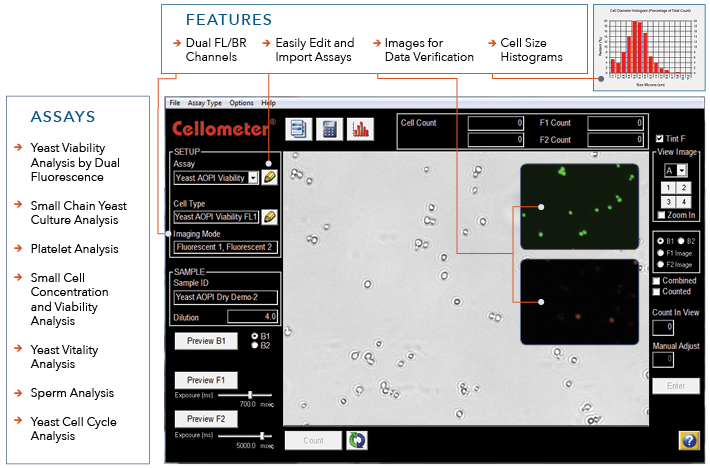
The Cellometer X2 utilizes bright field imaging, fluorescent imaging and pattern-recognition software to quickly and accurately identify and count individual cells. Cell count, concentration, diameter, and % viability are automatically calculated and reported.
 5x Faster than Manual Counting: Load sample, view image, count cells, and obtain results in < 60 seconds
Fluorescent Viability Determination
Fluorescent Analysis
Fluorescent dyes that stain DNA can be used to identify nucleated cells in a mixed cell population. Acridine orange (AO) is a nuclear staining (nucleic acid binding) dye permeable to both live and dead cells. It stains all nucleated cells to generate green fluorescence when imaged with the Cellometer X2.
Because mature mammalian red blood cells don’t contain nuclei, only mononuclear cells produce a fluorescent signal. Fluorescent-positive nucleated cells are easily counted. There is no need to lyse red blood cells, saving time and eliminating an extra sample preparation step.
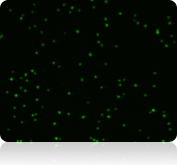
With propidium iodide (PI), dead cells are clearly visible in the red fluorescence channel.
Use of a fluorescent dye, such as propidium iodide (PI), is highly recommended for accurate viability analysis of cell samples containing debris.
Propidium iodide (PI) is a nuclear staining (nucleic acid binding) dye that enters dead cells with compromised membranes. It stains all dead nucleated cells to generate red fluorescence.
Because the Cellometer X2 can count dead cells in the red fluorescence channel, there is no interference from debris and live cells.
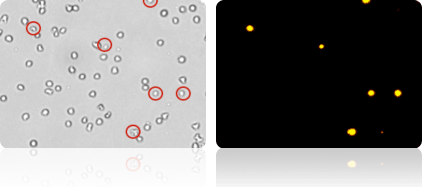
1-Step Yeast Concentration & Viability Analysis using Cellometer X2
Bright field and Fluorescent Imaging
The Cellometer X2 Image Cytometer is specifically optimized for simple, 1-step determination of yeast concentration and viability. The Cellometer X2 is ideal for research laboratories and small and large breweries looking to automate their fermentation monitoring. Performance of the Cellometer X2 has been proven in the largest breweries in the U.S.
Bright field images can be viewed to confirm cell morphology. Counted bright field images show counted cells within cell clumps. Fluorescent images show dead cells for confirmation of viability results. Analysis of both bright field and fluorescent images from each sample makes 1-step concentration & viability determination possible. Read more about yeast viability.
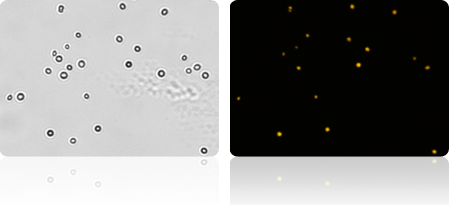
Bright field and fluorescent images of yeast cells. Cells appearing in both the bright field and fluorescent image are dead.
Yeast Concentration Measurement by Bright Field Analysis
Single Cell Count
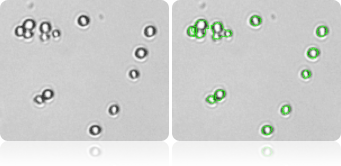
De-clustering of Yeast Cells
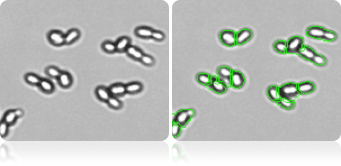
Chain-Forming Cell Count
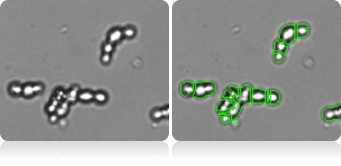
Yeast Concentration & Viability Measurement by Bright Field & Fluorescence
Viability Measurement Using Propidium Iodide (PI)
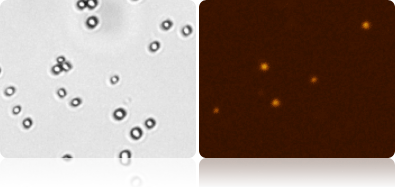
Bright field images are used to obtain total cell count, while fluorescent images are used to count dead cells.
Viability Measurement by Oxonol
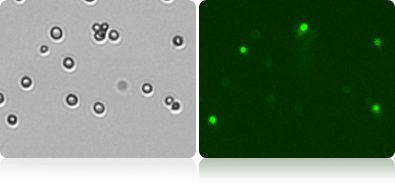
Bright field images are used to obtain total cell count, while fluorescent images are used to count dead cells.
Yeast Concentration Measurement by Dual Fluorescence Detection
Yeast Viability by Dual-Fluorescence
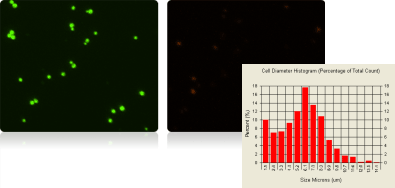
Yeast samples are stained 1-to-1 with a mixture of acridine orange (AO) and propidium iodide (PI) dual-fluorescence stain. Yeast concentration and viability are obtained immediately after staining using Cellometer X2. Live yeast cells fluoresce green and dead cells fluoresce red.
Yeast Vitality by Fluorescent Enzymatic Stain
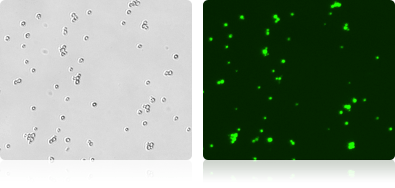
Yeast samples are stained 1-to-1 with Carboxyfluorescein-AM fluorescent enzymatic stain for 45 minutes and then analyzed for vitality using Cellometer X2. Bright field images are used for total cell count and fluorescent images are used to measure the active yeast cells.
Yeast Cell Cycle Analysis Using Propidium Iodide (PI)
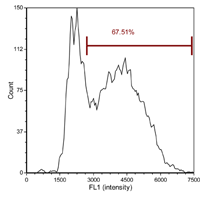
Standard baker’s yeast stained with the Cell Cycle Staining Kit from Nexcelom Bioscience are incubated for 60 minutes before using Cellometer X2 to analyze the cell cycle. The plot shows the yeast population that is actively dividing. Their higher DNA content is measured using PI.
Automated Platelet Counting in Whole Blood
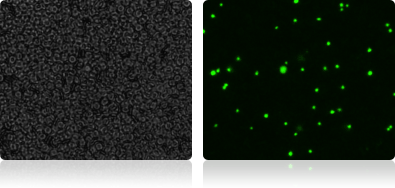
Fluorescence-Based Platelet Concentration. Measurement A blood sample stained using the Calcein AM Vitality / Viability Kit from Nexcelom Bioscience is incubated for 20 minutes. Both platelets and white blood cells produce green fluorescence. Cell size gating is applied to exclusively count platelets.
Exclusion of Debris & Size-Based Cell Counting
Because Cellometer recognizes cells based on size, brightness, and morphology, cellular debris is easily and accurately excluded from counting results.
- Cell size parameters can be modified to optimize exclusion of debris from results and enhance the accuracy of counting for a wide range of cell sizes.
- A fluorescent nuclear dye, such as acridine orange, can be used to more easily identify nucleated cells in samples containing debris.
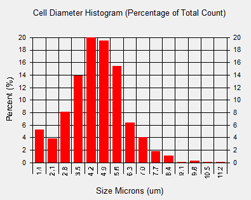
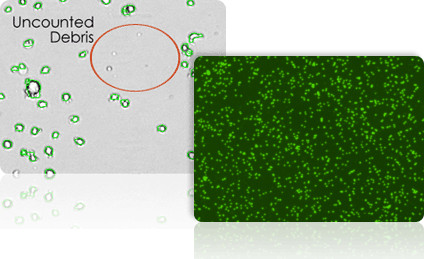
The Cellometer X2 Image Cytometer automatically generates a cell size histogram based on cell diameter.
The minimum and maximum cell diameter settings can be optimized to count specific cells in a sample.
View, Print, and Save Cell Images and Data Tables
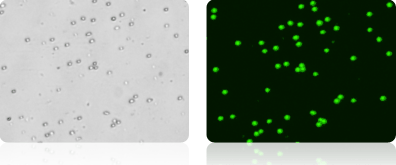
Bright field and fluorescent counted images of mouse splenocytes stained with acridine orange.
View bright field images to check cell morphology.
View fluorescent counted images to confirm exclusion of debris or unwanted cell types and correct counting of cells within clumps.
Export Data
Easily Export to Excel for additional data formatting or sharing. Images and data tables can be pasted into PowerPoint presentations or submitted for publication.
Save Data
Easily Save data and images to a network or local computer.
Print directly from the software screen. The standard printout displays live, dead, and total cell count and concentration, % viability, and cell images.
Cellometer X1 vs. X2
| Cellometer Yeast Analysis | Cellometer X1 | Cellometer X2 |
|---|---|---|
| Bright field imaging mode | X | X |
| Single fluorescence imaging mode | X | X |
| Dual fluorescence imaging mode | X | |
| Viability using PI | X | X |
| Concentration & viability using AOPI | X | |
| Vitality using CFDA-AM | X | |
| Yeast cell cycle | X | X |
| Cellometer software for analysis of clumpy and irregular-shaped cells |
X | X |
| Mean diameter and cell size distribution | X | X |
| Cell type wizard for creating new cell type parameters | X | X |
Counting Chambers: No Washing or Contamination
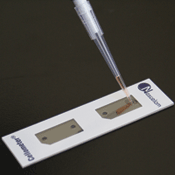
Cellometer Disposable Counting Chambers consist of two independent enclosed chambers with a precisely controlled height. Cell suspension of 20 microliters is loaded into the chamber using a standard single channel pipette.
The chamber is inserted into the Cellometer cell counter and the cells are imaged. This simple sample loading and analysis method is ideal for fragile cells.
The disposable Cellometer Cell Counting Chambers offer several key advantages:
- Time savings – no washing
- No risk of cross-contamination
- Reduced biohazard risk to users
- Controlled sample volume
- Most affordable automated counting consumables
Dedicated On-line and On-site Applications Support

Experienced Nexcelom Technical Support Specialists are available from 9 am to 5 pm EST for phone and online support and can assist with:
- Creation of new cell types
- Optimization of counting parameters
- Troubleshooting
- Training of new users
- Installation of a new Cellometer X2 Cell Counter

The help button at the bottom right of the Cellometer X2 software screen gives users instant access to:
- Software features and instructions
- On-line tutorials and training videos
- Submission of a Support Ticket

Clicking “Submit a Support Ticket” launches a convenient online form that is submitted directly to Nexcelom Technical Support
- X2 instrument information fields are automatically populated
- Images are easily attached for troubleshooting and applications support
- A Nexcelom Specialist can assume remote control of the Cellometer X2 Image Cytometer for troubleshooting and training

Nexcelom Field-based Applications Specialists are also available for:
- On-site demonstrations
- Training
- Troubleshooting
- Technical Seminars
All Nexcelom Applications Specialists are 100% focused on image-based cell concentration & viability and cell-based assays using Cellometer Image-Based Cytometry
Applications for Cellometer X2 Fluorescent Viability Counter


Yeast Concentration & Viability
Live yeast cell concentration and viability are measured automatically based on the membrane permeability of the fluorescent dye Oxonol. Multiple strains of yeast with viability ranging from 88 to 5% were measured. »
Performance of the Cellometer X2 Image Cytometer
Dynamic Range of Total Cells with Cellometer X2
Concentration Dynamic Range Figure 1 depicts the dynamic range for cell concentration measured by Cellometer X2. This data set was taken on a concentration series of cultured yeasts.
Samples from 2.5 x 10⁵ – 5 x 10⁷ cells/ml can be counted without further dilution.
The %CV at each concentration was below 10%.
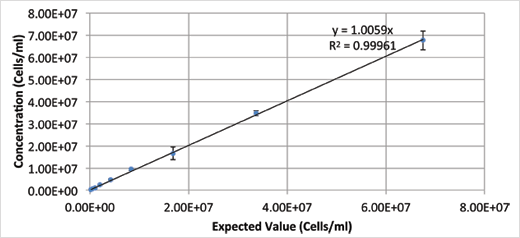
Figure 1: Table of results for cell concentration dynamic range
Cellometer X2 Repeatability and Consistency
| Cellometer X2 | Average Live Cell Concentration Via Fluorescence | Viability |
|---|---|---|
| AVE | 1.32E+07 | 78.1% |
| STDEV | 7.69E+05 | 2.2% |
| %CV | 5.84 | 2.78 |
Figure 2: Table of results for cell concentration and viability using acridine orange (AO) and propidium Iodide (PI)
The results indicate the accuracy of the Cellometer X2 instrument in assessing the viability of yeasts using AOPI for cell viability. Yeasts were tested at 24 sample replications. The viability average was calculated and plotted. The results show the reliability and accuracy of the Cellometer X2 in measuring cell concentration and viability of yeast cells.
Performance of the Cellometer X1 Image Cytometer
Dynamic Range of Total Cells with Cellometer X1
Concentration Dynamic Range Figure 3 depicts the dynamic range for cell concentration measured by Cellometer X1. This data set was taken on a concentration series of cultured yeasts.
Samples from 4 x 10⁵ – 5 x 10⁷ cells/ml can be counted without further dilution.
The %CV at each concentration was below 10%.
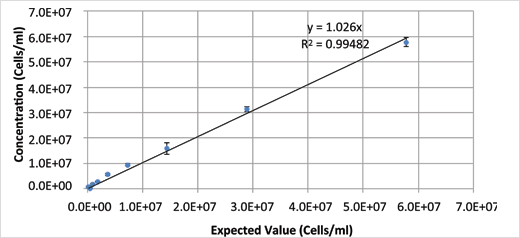
Figure 3: Table of results for cell concentration dynamic range
Cellometer X1 Repeatability and Consistency
| Cellometer X1 | Average Live Cell Concentration Via Bright Field | Viability |
|---|---|---|
| AVE | 4.07E+07 | 69.0% |
| STDEV | 2.28E+06 | 2.5% |
| %CV | 5.61 | 3.64 |
Figure 4: Table of results for cell concentration and viability using bright-field and Propidium iodide (PI)
The results indicate the accuracy of the Cellometer X1 instrument in assessing the viability of yeasts using PI for cell viability. Yeasts were tested at 24 sample replications. The viability average was calculated and plotted. The results show the reliability and accuracy of the Cellometer X1 in measuring cell concentration and viability of yeast cells.
Cellometer X1 and X2 Consistency and Accuracy Comparison to Hemacytometer
5 µm beads
| N = 20 | Hemocytometer | Cellometer X1 and X2 |
|---|---|---|
| AVE | 1.07E+06 | 1.10E+06 |
| STDEV | 5.90E+04 | 9.81E+04 |
| %CV | 5.5% | 8.9% |
Cellometer X2 Specifications
| Includes |
|
| Available Accessories |
|
| Imaging Performance |
Bright field imaging, fluorescent imaging and pattern-recognition software to quickly and accurately decluster, identify and count individual cells. |
| Instrument Specifications |
|
| PC / Laptop Minimum Requirements: (If purchasing Cellometer without PC laptop) |
Intel Mac with Parallels/Windows |
| Available Fluorescence Optics Modules | VC-535-403 Excitation / Emission: 470nm/535nm Example Fluorophores:
VC-660-503
|
Cellometer X2 Resources
Manuals
Product Literature
Videos
Unboxing and Getting Started with Cellometer X2
Autosave on the Cellometer X2
Applications Notes
Training Webinars
- Optimizing your Yeast AO/PI Viability Assays on your Cellometer
- Optimizing your Exposure Time and Focus Settings
- Yeast Viability Assay on the Cellometer X2
Posters
Customer Testimonials
A welcome addition
The Nexcelom [Cellometer] X2 unit we received is a welcome addition to our microbiology lab. It was very easy to set up, and a tech came out and walked us through proper usage, and set up assays for our house yeast strains. We are very happy to not have to rely on a hemocytometer and time-consuming gram-staining anymore!
function positionLinkBlock(targetContainer) { if (targetContainer != null) { var strLinkBlock = 'Hop Valley Brewing Co.
A welcome addition
The Nexcelom [Cellometer] X2 unit we received is a welcome addition to our microbiology lab. It was very easy to set up, and a tech came out and walked us through proper usage, and set up assays for our house yeast strains. We are very happy to not have to rely on a hemocytometer and time-consuming gram-staining anymore!
Hop Valley Brewing Co.
Save a lot of time
We’ve been able to save a lot of time in our yeast counting protocol, especially when working with multiple samples. Prepping and counting 5 samples doesn’t take much longer than doing just one and being able to automatically save the data makes record keeping a breeze.
function positionLinkBlock(targetContainer) { if (targetContainer != null) { var strLinkBlock = 'Utmost confidence
Using the X2 has revolutionized our ability to monitor our overall yeast health and performance. Allowing us to accurately harvest and re-pitch our yeast strains for successive generations with the utmost confidence.
function positionLinkBlock(targetContainer) { if (targetContainer != null) { var strLinkBlock = 'Hangar 24 Craft Brewing
The increased confidence in our cell counts in priceless!
The X2 has allowed us to increase throughput in our QC lab while maintaining a high degree of accuracy, eliminating much of the inter-operator variability associated with manual cell counting. The time savings and repeatability are tremendous, and the increased confidence in our cell counts in priceless!
function positionLinkBlock(targetContainer) { if (targetContainer != null) { var strLinkBlock = 'Michael Roosevelt
The increased confidence in our cell counts in priceless!
The X2 has allowed us to increase throughput in our QC lab while maintaining a high degree of accuracy, eliminating much of the inter-operator variability associated with manual cell counting. The time savings and repeatability are tremendous, and the increased confidence in our cell counts in priceless!
Michael Roosevelt
Improve yeast health
The [Cellometer] X2 has given us the ability to fine-tune our yeast management program and vastly improve yeast health. It has also been a great tool to standardize testing between brewing, lab, and cellar staff.
function positionLinkBlock(targetContainer) { if (targetContainer != null) { var strLinkBlock = 'Lindsey Kingry
Quickly measure yeast viability
I love my Nexcelom X2 Cellometer! It allows me to quickly measure yeast viability in my lab and for my customers! No more tedious counting yeast cells under the microscope via methylene blue.
function positionLinkBlock(targetContainer) { if (targetContainer != null) { var strLinkBlock = 'Sean Sleight
Customer Publications using Cellometer X2
Our customers include:
