Nexcelom Bioscience
Yeast

Yeast Concentration & Viability

Compatible with:

Yeast Overview

Importance of Yeast Analysis

Yeasts are an economically important organism used for ethanol production in the beverage and alternative fuels industries as well as a leavening agent in the baking industry. In addition, pathogenic strains of yeasts are involved in both plant and animal diseases. Concentration and viability determinations are routinely performed for quality control purposes in yeast production, fermentation processes, and fungicides research to monitor proliferation of pathogenic yeasts.

The most common method for determining yeast cell number and viability is manual counting on a standard microscope using a hemacytometer and a viability dye. One advantage of this method is that visual inspection of each sample allows the operator to check for contamination, presence of interfering debris, and obvious dilution errors. A major disadvantage is that the manual method is laborious, error-prone and the data acquired is not easily traceable. Although the equipments used to perform manual counting are relatively inexpensive, the cost of human labor and counting errors can be high enough to render manual counting less than practical in a production facility where accuracy, consistency, and record-keeping are highly desirable.

Fluorescence Based Image Cytometry Method for Yeast Concentration & Viability Measurement

1. Pipette 20 µl of sample

Pipette 20 µl of cell sample into a disposable counting slide

2. Insert slide

Insert slide in to cell counter

3. Click count and get results

select cell cycle assay

How Does Yeast Count & Viability by Dual Fluorescence Work?

Highly viscous corn mash sample

A highly viscous corn mash sample is mixed with a dilution buffer and stained with nucleus staining dyes.


Live nucleated cells emit green fluorescence when excited by blue light.

Dead cells emit red light when excited by green light.

Live and dead cells are then distinguishable by color and viability is generated as a percentage based on live/total cell count.

Back to top ↑

Yeasts Used in Brewing Industry

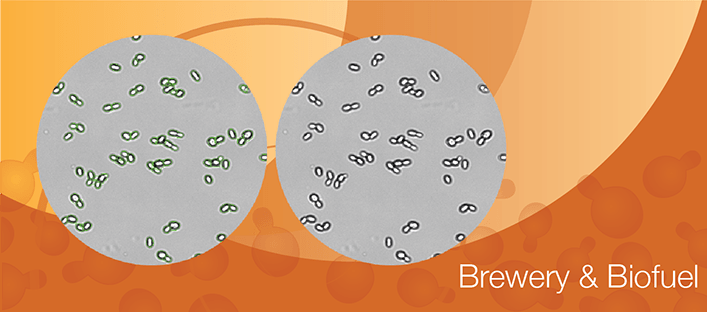
In general, yeasts used in brewing are very clean and easily counted using Cellometer image cytometer bright-field capability. In addition, in order to measure the viability of the yeast sample, propidium iodide (PI) or oxonol are fluorescent viability dyes that can stain dead cells. Therefore, the total cell count is measured in bright-field images and dead cell count is measured in the fluorescent images.

Yeast Concentration Measurement by Bright-Field Analysis

Single Cell Count

Yeast single cell count

Munton's rehydrated yeasts were automated counted using Cellometer in bright-field to measure cell concentration and cell size.

De clustering of Budding Cells

Decluster budding yeast cells

Advanced software de-clustering algorithm can de-cluster budding yeasts to individual cells to generate more accurate concentration and size measurement.

Chain-Forming Cell Count

Yeast Chain-Forming Cell Count

Advanced software de-clustering algorithm can also de-cluster chain-forming yeasts to individual cells to generate more accurate concentration and size measurement.

Cell Concentration Linear Range and Reliability

Serial two-fold dilutions of rehydrated yeast were counted on the Cellometer Auto X4 (10x) to determine the linear range for reliable yeast concentration measurements. The range of concentration that can be measured on the instrument is dependent on the size of the cell being counted (i.e. the range decreases as cell size increases). The Muntons strain is approximately 4.5 µm in diameter when rehydrated, and was selected for this experiment due to its intermediate size when compared to other yeast strains such as those used for lager beer or wine production. The upper limit for accurate yeast counting, as determined by examining counted images, represented a four-fold dilution of the original concentrated yeast suspension (Dilution 2) at 6.6 x 10⁷ cells/mL. Serial dilutions of this sample were counted until the lower limit was reached (Dilution 6) at a concentration of 4.17 x 10⁶ cells/mL.

Plotting of the measured concentration versus the concentration factor (inverse of the dilution factor) resulted in a linear relationship with an R2 of 0.9968. Thus the linear range for counting Muntons yeast (and other similarly sized strains around 4.5 µm in diameter) on the Cellometer Auto X4 (10x) is between 4 x 10⁶ and 6.6 x 10⁷ cells/mL (Figure 1A).

Repeated measurements were performed on the sample to determine the reliability of counting by calculating the Coefficient of Variation (CV). Within the linear range for counting yeast on the Cellometer Auto X4 (10x), the CV was between 4% and 13% (Figure 1B).

A

Cell concentration linear range and reliability

B

Dilution
Mean Concentration
CV
2
6.58E+07
6%
3
2.99E+07
4%
4
1.55E+07
7%
5
8.84E+06
10%
6
4.17E+06
13%

Figure 1. Linear range of accurate yeast concentration measurements and corresponding CV values.

Yeast Concentration & Viability Measurement by Bright Field & Fluorescence

Viability Measurement Using Propidium Iodide (PI)

Yeast viability by PI

Munton's yeasts were allowed to rehydrate for 30 min, and then stained 1-to-1 with propidium iodide (using FOM VB-595-502 or VB-660-502). The yeasts were immediately analyzed using Cellometer to measure the viability, concentration, and cell size. The bright-field images were counted to measure total cell count, while the fluorescent images were counted to measure dead cell count.

Viability Measurement by Oxonol

Yeast viability by Oxonol

Munton's yeasts were allowed to rehydrate for 30 min, and then stained 1-to-1 with oxonol (using FOM VB-535-402). The yeasts were analyzed after 5 min incubation, using Cellometer to measure the viability, concentration, and cell size. The bright-field images were counted to measure total cell count, while the fluorescent images were counted to measure dead cell count.

Cell Viability Measurement Accuracy and Reliability

Aliquots of the live yeast suspension were mixed with the heat-killed yeast to generate samples at various levels of viability. The measured viability of the live yeast sample was 78% while the heat-killed sample was 0%. Fractions of live and dead yeast were mixed to analyze intermediate viability levels.

The measured viability was plotted against the percent of heat-killed cells in the final mixture and gives a linear correlation with an R2 of 0.9996. Comparison of predicted and measured viability showed a high degree of agreement and replicates of viability measurements had a standard deviation of ≤ 1.3% (Figure 2A,B). Taken together, viability measurements using PI on the Cellometer Auto X4 (10x) are both highly reproducible and reliable.

A

Cell concentration linear range and reliability

B

Live/Dead
Predicted
Measured
St Dev
100%/0%
-
78%
0.4%
75%/25%
59%
58%
1.2%
50%/50%
39%
39%
0.6%
25%/75%
20%
19%
1.3%
0%/100%
0%
0%
0.4%

Figure 2. Accuracy and reliability of viability measurements of live yeast mixed with various quantities of heat-killed yeast.

Back to top ↑

Yeasts Used in Biofuel Industry

In general, yeasts used in the biofuel industry are in complex medium such as corn mash, corn stover, or sugar cane, which can serve as nutrients to produce bioethanol. These complex media increase the difficulties for automated counting using bright-field method due to the debris particles in the sample. Using a combination of acridine orange (AO) and propidium iodide (PI) can perform dual fluorescence detection of live and dead cells, respectively, which can specifically stain the live/dead cells to accurately determine the concentration and viability of the complex sample.

Yeast Concentration & Viability Measurement with Corn Mash Debris

Yeast corn mash debris

Yeast Concentration & Viability Measurement with Corn Stover Debris

Yeast corn stover debris

Yeast Concentration & Viability Measurement with Sugar Cane Debris

Yeast sugar cane debris
Above shows 3 complex samples of corn mash, corn stover, and sugar cane. The bright-field images contain many debris particles, but in the fluorescent images, only the yeast cells fluoresce brightly that can be automatically counted.

Measuring Yeast Viability Using AOPI

Yeast by AO PI
Yeast AO PI results
  • Yeast sample was monitored during ethanol fermentation
  • Early in fermentation at ~90%
  • Below 30% at the end of the fermentation
  • Consistent with manual counting method

Back to top ↑

Advanced Yeast Analysis Assays

Yeast Vitality Analysis Using CFDA-AM & Propidium Iodide

Yeast Vitality Analysis using CFDA-AM & Propidium Iodide

The brewing yeasts were stained for 1 hour with CFDA-AM (using FOM VB-535-402) to measure enzymatically active yeasts. After incubation, the cells are immediately analyzed using Cellometer to measure the number of enzymatically active yeasts to determine the vitality of the sample. The percent of yeasts that are actively fermenting during production can be determined and used to optimize the fermentation process. The fluorescent linear gating was set to measure the population percentage of high CFDA-AM fluorescence.

Yeast Glycogen Content Using Acriflavine Fluorescent Staining

Yeast Glycogen Content using Acriflavine Fluorescent Staining


Yeast glycogen is a macromolecule that provides the energy and carbohydrates required for yeast sterols and lipid synthesis, which ensures yeast metabolism during fermentation. Glycogen content can be measured by staining with acriflavine (using FOM VB-535-402) and analyze fluorescence intensity of individual cells in a fluorescent histogram. Glycogen has been shown to correlate to vitality and is an essential physiological parameter to be monitored.

Yeast Neutral Lipid Content Using Nile Red Fluorescent Staining

Yeast Neutral Lipid Content using Nile Red Fluorescent Staining


Neutral lipids are energy rich molecules that are stored in yeasts, which cannot be metabolized. However, it can protect yeast cells from toxic substances like ethanol, which can prolong survival capacity. In order to measure neutral lipids, the yeasts can be stained with Nile Red (using FOM VB-595-502), and analyze fluorescence intensity of individual cells in a fluorescent histogram. The fluorescent linear gating was set to measure the population percentage of high Nile Red fluorescence.

Yeast Trehalose Content Using Concanavalin A-FITC Fluorescent Staining

Yeast Trehalose Content using Concanavalin A-FITC Fluorescent Staining


Trehalose is a sugar disaccharide that supplies energy during cell cycle, or cell proliferation. Similar to neutral lipids, trehalose can protect yeast cells against stress, high ethanol content, heat, dehydration, oxidation, pH change. In order to measure trehalose content, the yeast cells are stained with concanavalin A-FITC (using FOM VB-535-402), and analyze fluorescence intensity of individual cells in a fluorescent histogram. Trehalose are also known to increase survival capacity during fermentation. The fluorescent linear gating was set to measure the population percentage of high FITC fluorescence.

Back to top ↑

Yeast Green Fluorescent Protein (GFP) Transfection

Yeast GFP

Green fluorescent proteins expression in yeasts can be measured using Cellometer (using FOM VB-535-402). Bright-field images are analyzed initially to count all the cells and the fluorescence intensities within each cell are measured and plotted in a histogram for analysis. The fluorescent linear gating was set to measure the population percentage of high GFP fluorescence.

Back to top ↑

References

Yeast concentration and viability measurement
— JIMB 38:8, 1109-1115
— JIMB 39:11, 1615-1623
Strain development
— FEMS Microbio. Eco. 80:3, 578-590
— Int. J Food Microbio. 157:1, 45-51
Monitoring production quality
— BioControl 57, 451-461
— FEMS Microbio. Eco. 76:1, 145-155

Back to top ↑